Even great products hit growth plateaus. This article explores the hidden reasons why, from weak activation and messy analytics to feature overload and lack of focus. You'll learn how to run a fast diagnostic, refocus your roadmap on the right metrics, and restart sustainable product growth without relying on more ads or luck.
Sometimes growth stalls after the first few thousand users. Other times, it never really takes off.In both cases, the underlying problem is the same: your product isn't systematically turning attention into retained value.
For early-stage teams, that usually means marketing and positioning aren't clear enough, people don't yet understand why they should care.
For more mature products, the challenge shifts to activation, retention, and focus, users arrive, but don't stay or grow their engagement.
Either way, sustainable growth begins not with guessing, but with diagnosing what's truly holding you back.
Growth problems depend on where you are
It's easy to blame "marketing" for everything, but the real question is:What kind of marketing problem are we talking about?
| Stage | Typical Growth Problem | Focus Area |
|---|---|---|
| Early stage | Not enough traffic, unclear value proposition, low CTR | Positioning, messaging, channels |
| Post-launch | Users come but don't activate or stay | Activation, onboarding, retention |
| Scaling stage | Many features, no clear growth direction | Process, prioritization, analytics |
The usual suspects behind a growth plateau
Different stages, different bottlenecks, but the patterns repeat. Use this list to frame your first hypotheses.- Weak activation: users don't reach their first meaningful success ("aha") quickly.
- Analytics blind spots: no single source of truth; events don't map to the funnel.
- Feature factory: roadmap not tied to metrics; success is "shipped", not "moved KPI".
- Missing hypothesis cycle: ideas aren't tested; experiments lack clear expected impact.
- Poor focus: chasing trends instead of doubling down on what works.
How to Diagnose Quickly
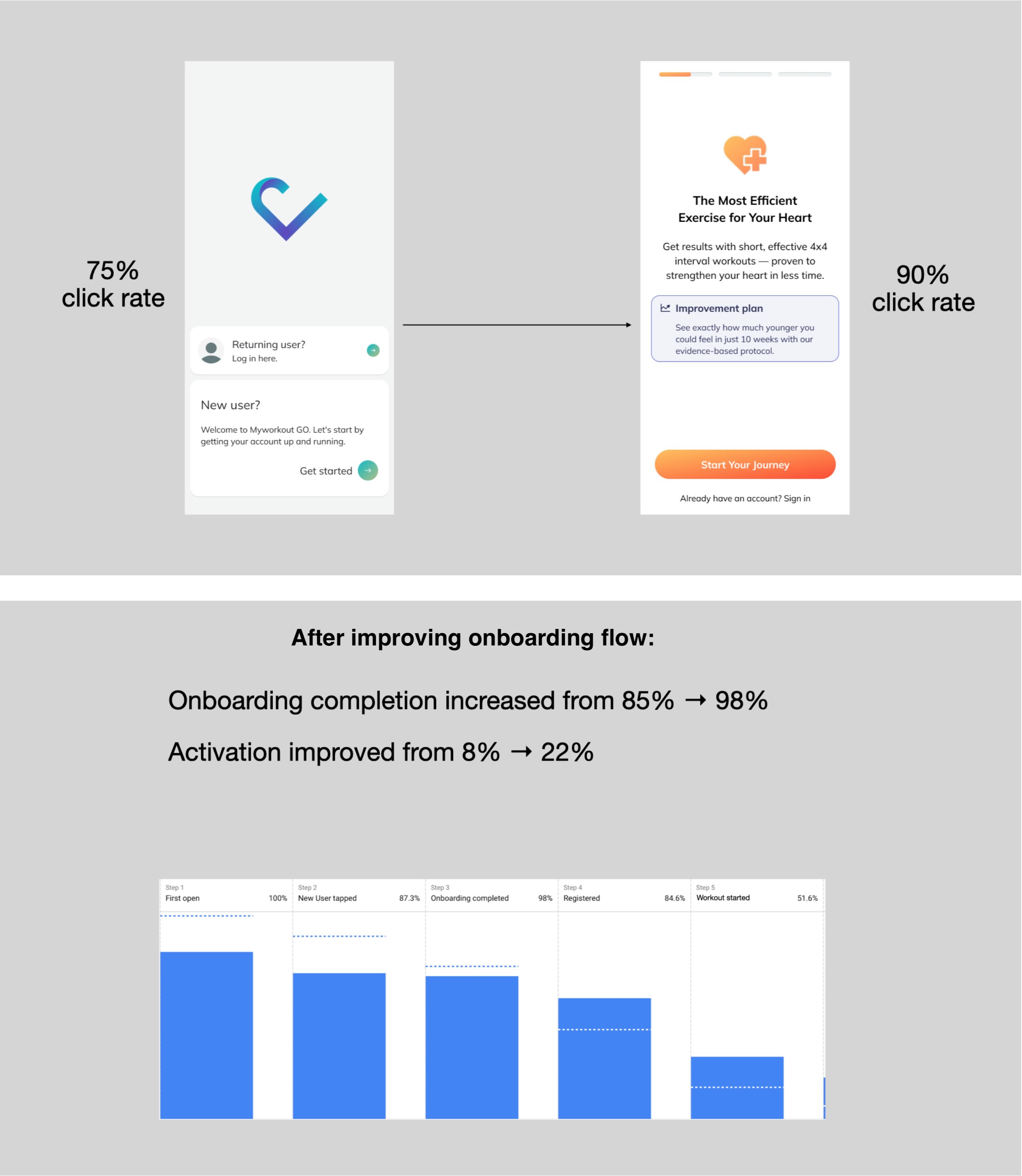
Before you fix anything, you need to know what's actually broken. Many teams jump into new features without understanding the root cause. A fast diagnostic requires structured thinking, not new tools.- Define your activation event and measure install→activation conversion.
- Plot retention curves (D1/D7/D30) and cohort views by source/feature.
- Map the onboarding path; mark drop‑offs and friction points.
- List top 10 features shipped recently; write which KPI each was meant to move and whether it did.
Pro tip: If you can't name the target metric and expected lift for a feature, it isn't ready to ship.
A Lightweight Restart Plan
Once you've found the weak spots, resist the temptation to rebuild everything at once. Growth is regained through focus, not volume. Use this four‑week cadence to restore momentum without adding complexity.- Pick one north-star goal (e.g., Trial→Paid, WAU, or D7 retention).
- Run a 4‑week cycle: discover → prioritize → experiment → learn.
- Start with activation and first‑value delivery; these compound.
- Ship small, measurable changes weekly; archive anything without a metric.
Checklist
You've identified issues, tested improvements, and captured learnings. Before moving on, make sure these foundations are in place, they're your safety net against future plateaus.- Activation defined and tracked
- Retention curves by cohort
- Roadmap tied to KPIs
- Experiment docs with expected impact
- Weekly review of what actually moved
Final Thoughts
Growth isn't magic, it's the result of clarity, measurement, and consistent learning. Every product that feels "stuck" is really just one insight away from moving again. The key is to stop guessing, start observing, and turn those insights into action. Once you do, growth stops being a mystery, it becomes a habit.Written by X91 Tech, Growth Studio for Digital Products.